
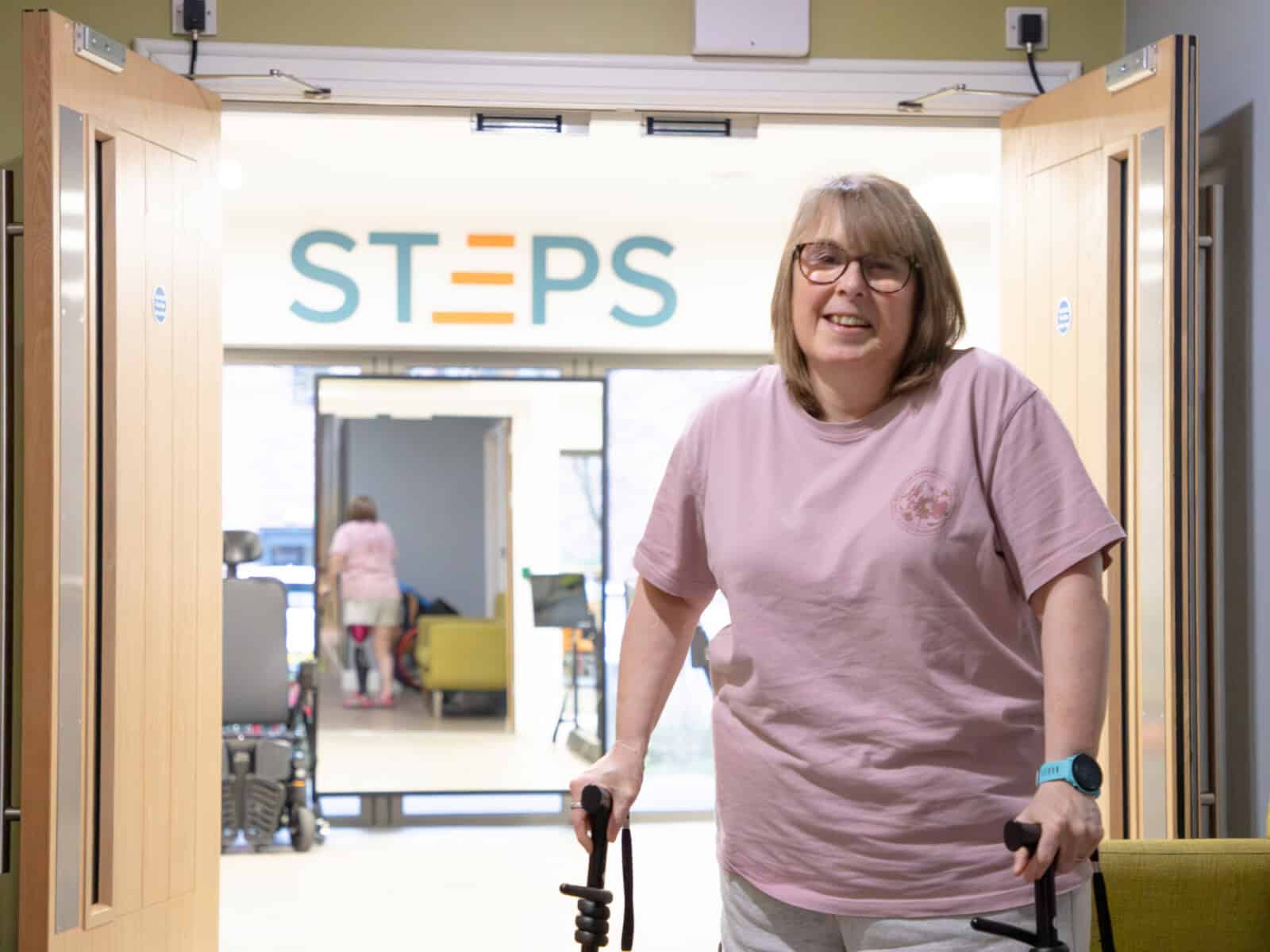
Sharon, a 54‑year‑old teaching assistant from a village primary school in North Yorkshire, lived a busy and active life before her accident. She balanced full‑time work with caring for her mother, walking her dog, and enjoying regular long‑distance hikes, including climbing Ben Nevis to celebrate her 50th birthday.
On 17th April 2024, Sharon was involved in a catastrophic head‑on collision on a rural road she knew well. A car travelling on the wrong side of the road struck her on a blind bend, leaving her with life‑threatening polytrauma.
Air‑lifted to James Cook Trauma Centre in Middlesbrough, Sharon was placed in an induced coma for two and a half weeks. Her injuries included a severely damaged left foot, multiple fractures to her femur, back, sternum and ribs, a punctured lung, and internal injuries requiring bowel surgery. She also sustained irreparable trauma to her right leg, leading to an above‑knee amputation.
After 12 weeks in hospital, followed by a month of early rehabilitation at Malton Hospital, Sharon began standing and pivoting on her injured left leg and no longer required a banana board for transfers.
This case study demonstrates how STEPS Rehabilitation’s integrated residential model, combining therapy, medical expertise, psychology, hydrotherapy and on‑site prosthetic provision delivered in partnership with STEPS Prosthetics enabled Sharon to make rapid, meaningful progress. It also highlights the crucial role of peer support in helping her rebuild confidence, function and independence after catastrophic injury.
Instructing a Solicitor and Case Manager: Early, Specialist Intervention
With support from the Day One Trauma Support Charity, Sharon and her husband were signposted to several catastrophic injury law firms before instructing Irwin Mitchell. Sharon was initially represented by Claire Newstead, and later by her colleague Peter Lorence following Claire’s retirement in January 2025.
Peter outlined Irwin Mitchell’s wider approach to early, coordinated rehabilitation:
“Irwin Mitchell’s approach centres on early engagement with the insurer to secure prompt support, appoint an appropriate case manager, and establish a cohesive rehabilitation plan. Through this collaborative process, funding for Sharon’s residential stay at STEPS was approved, ensuring she could access the intensive, multidisciplinary input and on‑site prosthetic expertise she required.”
With funding secured, a joint instruction appointed Kirsty Laird of COTA Case Management, an expert in complex polytrauma and amputee rehabilitation. Meeting Sharon six weeks after she returned home, Kirsty quickly identified significant barriers to progress: limited community rehabilitation, an unsuitable wheelchair, and a home that was only partially accessible.
She acted swiftly to arrange appropriate equipment, secure psychological support, liaise with NHS teams, and begin planning for future rehousing, whilst also recommending a residential stay at STEPS and arranging Sharon’s initial assessment.
Admission to STEPS: Rehabilitation and Prosthetics Under One Roof
Sharon attended her prosthetic and rehabilitation assessment in April 2025 with Peter Durkin and Joanna Fakayode. Crucially, with the prosthetics workshop based on site, casting and preparation could begin immediately, ensuring her therapy and prosthetic fitting were underway from the very first day of her residential stay.
Within the first three days of her 12‑week programme, Sharon was:
- Walking with a Kenevo microprocessor knee
- Beginning intensive gait re‑education
- Participating fully in interdisciplinary rehabilitation
She recalls her first impressions:
“Absolutely amazing. You come through the doors, and you feel so welcome. Everybody knows you and your name. You know that if I need help, there’s always somebody there I can ask. It’s such a lovely atmosphere to be in, so caring and nurturing.”
Sharon’s NHS‑issued prosthesis had limited her gait and encouraged compensatory patterns. Through STEPS Prosthetics, she accessed a far more advanced and responsive approach and was able to trial a number of different prostheses:
- Progression from the Kenevo to the Össur Navi and Ottobock Genium X4
- Real‑time socket adjustments as her activity increased
- A lower‑profile, sub‑ischial socket enabling her to sit on low classroom chairs, reach the floor and work safely with children
By the end of her first admission, Sharon was walking indoors and outdoors with two sticks. Her second stay focused on refining her gait further, progressing to one stick, and building confidence in community environments.
Interdisciplinary Rehabilitation at STEPS
STEPS delivers a full interdisciplinary programme, with therapy, medical care and prosthetic provision all based on site and coordinated daily towards a unified set of rehabilitation goals.
Early Vestibular Intervention
Shortly after admission, Sharon reported dizziness and was assessed immediately by Senior Physiotherapist and vestibular specialist Hannah Wright. She was diagnosed with BPPV using the Dix–Hallpike test and treated effectively with the Epley manoeuvre.
This early intervention allowed Sharon to participate fully in therapy from the outset. As Hannah explains:
“After treating the initial dizziness, we moved straight into vestibular and balance rehabilitation. I carried out a full balance assessment with Sharon, looking at her static, dynamic, proactive and reactive balance, as well as her gait stability, it all links together. From there, we were able to crack on and really get stuck into the rehab, using lots of gameplay, habituation exercises and functional challenges to make the work both effective and enjoyable.”
Sharon then continued with targeted vestibular rehabilitation, including gaze stabilisation, VOR training and habituation exercises, supported by technology in the RehabHub such as MindMotion™ GO and BlazePod®.
Physiotherapy
Sharon received daily specialist amputee physiotherapy with Scott Pearson, Specialist Rehabilitation Physiotherapist which focused on restoring mobility, balance and gait.
- Microprocessor knee gait re‑training
Gait refinement using the Kenevo, Össur Navi and Genium X4, focusing on timing, step length and weight‑bearing. Outcome measures were used to track progress.
- Sensory re‑education, balance training and fall‑prevention
Ankle stabilisation, Kinesio taping, asymmetrical strengthening and dynamic balance tasks using BlazePod® and balance pads.
- Functional strength and endurance building
Core, hip and upper‑body strengthening delivered through engaging tasks such as balloon tennis and archery.
- Outdoor mobility, uneven‑ground practice and Parkrun participation
Training on varied terrains including grass, gravel, slopes and kerbs. A key achievement was completing a local Parkrun, partly self‑propelled and finishing on foot with two sticks.
Occupational Therapy
Daily OT sessions with Senior Occupational Therapist, Olivia Espley supported Sharon’s independence at home and her return to work.
- Return‑to‑work preparation
Classroom‑specific tasks including low‑chair transfers, floor‑level activity and stair practice.
- Dynamic balance, reaching, bending and floor transfers
Hands‑on practice supported by MindMotion GO to improve stepping, posture and core stability.
- Real‑world tasks and dressing techniques
Kitchen tasks, dressing, bed‑making and washing. Sharon explored adaptive clothing ahead of a family wedding.
- Fatigue management and pacing
Use of pacing strategies, activity planning and adaptive equipment such as a perching stool.
- Community confidence‑building
Supermarket visits, new sports and a tailored treasure hunt to build confidence and motivation.
Hydrotherapy
Hydrotherapy was one of Sharon’s favourite therapies during her stay. It reinforced her progress by offering:
- Relief from pain and phantom limb symptoms
- Supported standing and early gait practice in reduced gravity
- A safe and confidence‑building environment
Community and Peer Support at STEPS
The residential setting at STEPS fosters a strong peer community where clients support one another throughout rehabilitation. For Sharon, being surrounded by other amputees provided shared experience, emotional reassurance and genuine motivation.
“The community at STEPS has been incredible. During this stay there were many other amputees, and having people who share similar experiences makes such a difference… Knowing others have faced the same challenges and feelings is genuinely reassuring.”
Group activities, including the local Parkrun and team‑based treasure‑hunt therapy sessions, played an important role in Sharon’s confidence and connection with others.
Outcomes and Ongoing Progress
Across two residential stays, Sharon achieved:
- Independent walking indoors and outdoors with a microprocessor knee
- Progression from wheelchair use to walking with sticks
- Significantly improved balance, reduced dizziness and increased confidence
- A return to work as a teaching assistant
- Ability to sit on low chairs, reach the floor and fully participate in classroom life
- A return to driving
- A clear pathway towards long‑term goals such as hill‑walking and community fundraising
The Future
Sharon has now returned to work and is preparing to move into an accessible home near her school. She is also looking forward to having donkeys, both as pets and as therapy animals for the children and is planning a road trip to Scotland with her sister. Reflecting on her time at STEPS, Sharon says:
“Residential rehabilitation at STEPS feels like an extension of your family. If you’re willing to put in the hard miles, they’ll do them with you, they’re with you every step of the way. If any issues arise, they’ll sort them out, and if something doesn’t work, they’ll always find another way.”