
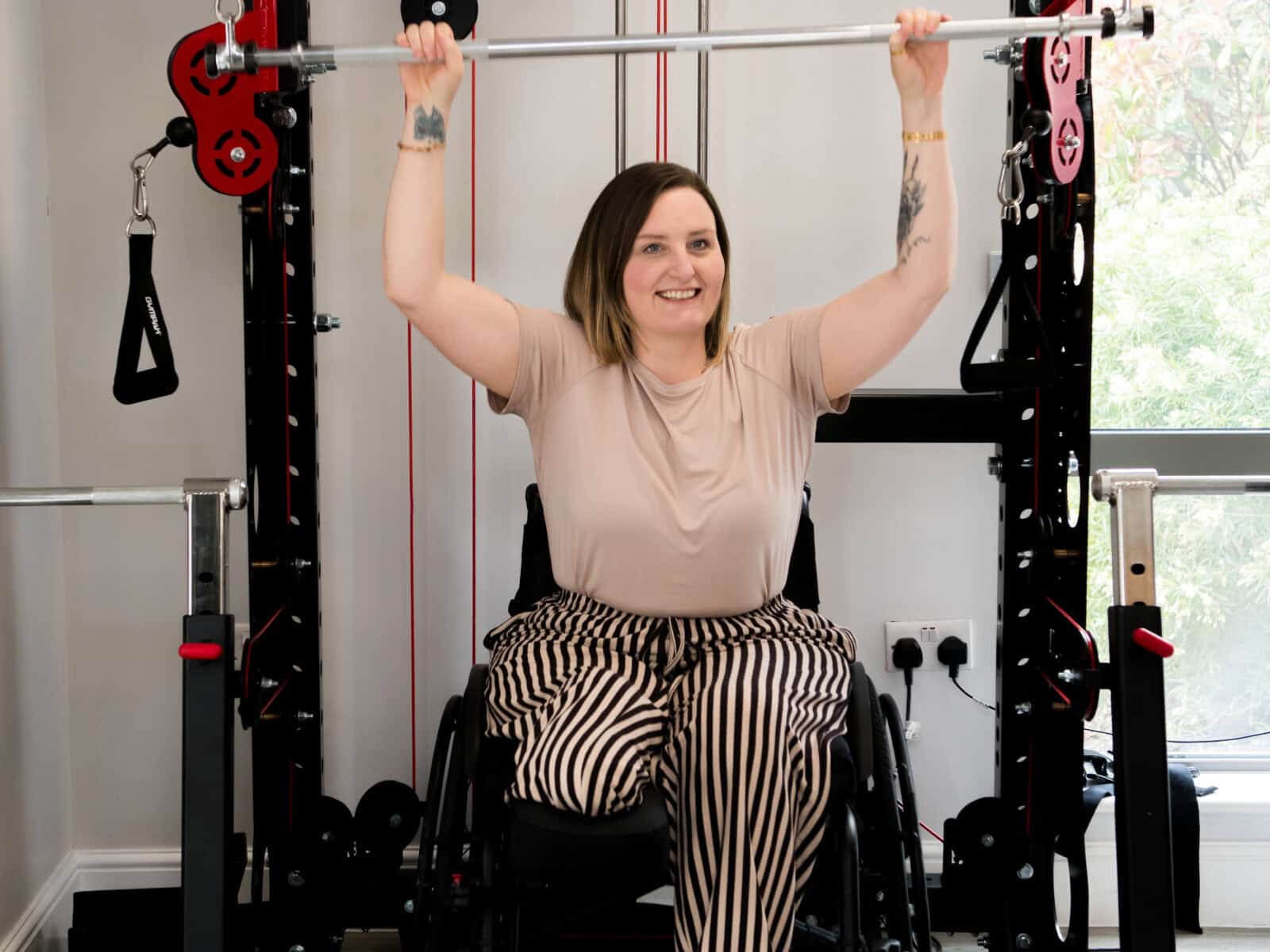
Sarah, a mum to her young son, sustained extensive injuries to both legs in an accident at work in September 2024. Her dad, Neil, who worked at the same site, was called to the scene in the immediate aftermath. He has supported Sarah throughout her recovery and continues to help her and her son at home.
This case study demonstrates how STEPS Rehabilitation's integrated residential model, combining therapy, psychological support and on-site prosthetic provision in partnership with STEPS Prosthetics, enabled Sarah to begin her rehabilitation straight after her elective amputation at the Harborne Hospital, Birmingham. It also highlights how close collaboration between Sarah's legal team, her case manager and the STEPS team ensured she received the right support at the right time.
The Accident
While at work, Sarah was struck by a forklift truck and trapped beneath it, sustaining severe injuries to both of her legs. She was airlifted to Sheffield's Northern General Hospital, where she went on to spend several months undergoing treatment.
Sarah describes the months following the accident as an "extremely painful and relentless" period. The damage to her right leg eventually left her facing an incredibly difficult choice: whether to undergo an elective amputation.
"I was broken and it was breaking me," Sarah said.
Legal Support and Case Management
In October 2024, Sarah instructed Leigh Day as her solicitors. Her solicitor, Beth Greenwood, worked closely with her case manager, Kirsty Laird, to support Sarah as she considered undergoing an elective amputation, helping her to explore her options and understand what life after surgery could look like. Once she had made her decision and funding was secured, they arranged private surgery at the Harborne Hospital, Birmingham and was admitted to STEPS days later on the 17th March 2026.
"Elective surgery is bizarre," Sarah said. "I never would've wanted to have my leg amputated. But I am very glad that I did it."
While arranging her surgery, Beth and Kirsty also secured Sarah a place at STEPS. This careful planning meant that, immediately following surgery, she was able to transfer straight to STEPS Rehabilitation for a two-month residential stay. From the outset, STEPS Prosthetics worked alongside her therapy team to prepare her for using a prosthesis.
Rehabilitation Following Elective Amputation
During the first few weeks after surgery, Sarah was not yet ready to begin weight-bearing with a prosthesis. The therapy team used this time to prepare her physically for the next stage of her rehabilitation.
Sarah Drury, Clinical Specialist Physiotherapist in Amputee Rehabilitation at STEPS Prosthetics, explains: "That gave us the brilliant opportunity to work on background strength, range of movement and stability. They are all really important building blocks for prosthetic rehabilitation."
Interdisciplinary Rehabilitation at STEPS
Once Sarah had recovered sufficiently from her surgery, STEPS Prosthetics produced a diagnostic socket, and weight-bearing was gradually introduced into her therapy sessions. Soon afterwards, Sarah was able to stand on her prosthesis for the first time.
"It was exhilarating," she said. "I think I felt more like myself, but then seeing myself as well was the first time I saw myself genuinely smile."
From there, Sarah continued an intensive programme of therapy to build her strength and balance. Alongside her physical rehabilitation, she received psychological support to help her come to terms with the impact of her injuries and amputation. Throughout her stay, the nursing, therapy and prosthetic teams worked closely together, continuously adapting her programme to ensure she achieved the best possible outcomes.
Outcomes and Ongoing Progress
Sarah's commitment to her rehabilitation enabled her to make excellent progress over a relatively short period of time. By the end of her stay, she was walking indoors with one stick and outdoors with two.
Her progress was also reflected in the outcome measures and assessments used to track her strength and mobility throughout her admission. As Sarah Drury explains, "Before she left, we repeated all those outcome measures, all of which showed massive improvements since her admission at STEPS Rehabilitation."
Speaking about her rehabilitation, Sarah said:
"I'm very grateful, because I couldn't see the light at one point. The difference is now I can't be sure, but I can be optimistic, whereas before I just didn't know."