
Bob's Life Before the Accident
Before his accident, Bob was 35, self-employed and running his own business converting camper vans. He was married with an eight-year-old daughter and living near Preston. He had a busy life, was an avid climber and motorcyclist; regularly touring Europe on his bike.
The Road Traffic Collision
On 22nd May 2021, Bob was riding to help his brother-in-law move furniture when a car pulled out in front of him. He collided with the side of the vehicle at 48mph. When Bob failed to answer his phone, his wife and brother-in-law drove the route they knew he would have taken and found the road closed, where a police officer told them there had been a serious motorbike collision.
He was assessed at the scene using the Glasgow Coma Scale (GCS 5) that placed him among the most critically injured. Bob was taken by air ambulance to Royal Preston Hospital, where scans revealed extensive damage to his brain.
Injuries Sustained and Emergency Treatment
Bob sustained a traumatic brain injury, punctured lungs and broken ribs. In hospital, surgeons first drilled a burr hole in his skull to relieve pressure, before carrying out a large decompressive craniotomy, removing a substantial section of skull. Once the swelling had subsided, a titanium plate was fitted. In total, Bob underwent around eleven operations on his brain and skull, including the insertion of a shunt to drain fluid from his brain.
He remained in a coma, with a tracheostomy to support ventilation for around nine months, he was treated for serious multiple infections and spent 14 months in hospital in total.
Being Told He Had "No Rehabilitation Potential"
When Bob began to show the first small signs of improvement, he was decannulated and discharged from hospital to Cleveland House, a specialist rehabilitation centre in Southport. His transfer notes carried a label that would come to define much of his early recovery: "no rehabilitation potential."
Within a week or two, staff recognised that this initial assessment had been incorrect. Bob was clearly demonstrating rehabilitation potential and continued capacity to progress. He remained at Cleveland House for around four months before being referred to STEPS Rehabilitation by his case manager.
As solution-focused hypnotherapist Jessika Sheppy, who worked closely with Bob, explains, the psychological impact of that early label was significant and long-lasting.
"Hearing 'you have no rehabilitation potential' can have a huge psychological impact. It takes away hope for the future, and you need hope when things are difficult in rehab, to move forward and meet challenges. It becomes a self-fulfilling cycle: why would I do this if I have no rehabilitation potential? It was really hard for Bob to move past having been told that."
Arrival at STEPS Rehabilitation
Bob arrived at STEPS Rehabilitation at the end of July 2022 with no understanding of what had happened to him, where he was, or any memory of his life before the accident. Over time, he began to understand that he had been involved in a motorbike collision.
At that point, he was using a wheelchair full-time, was doubly incontinent and needed at least two staff members to assist with every transfer. He presented with significant spasticity and neurological weakness down his right side, affecting both his upper and lower limbs, alongside reduced trunk control, right-sided neglect and significant retrograde amnesia.
Physiotherapist Kostas Falidas, who worked with Bob throughout his stay, recalls his first impressions.
"On his first day, Bob needed the assistance of two staff members to transfer, and had significant weakness on his right side, in both his upper and lower limb, with limited range in his right shoulder. He also presented with neglect on his right side; he could follow verbal commands but responded much better to visual cues."
Despite his physical presentation, Bob's determination was clear from the outset. From his very first day at STEPS, he began talking about personalised goals to work towards, his main goal being able to walk his eight-year-old daughter to school unaided.
An Interdisciplinary Team Approach to Rehabilitation
Bob's rehabilitation combined intensive physiotherapy and occupational therapy with speech and language therapy, neurologic music therapy, solution-focused hypnotherapy, art psychotherapy and peer support groups, in a genuinely interdisciplinary programme built around his personal goals.
Physiotherapy focused on reducing overall fatigue and weakness, particularly on his right side, with sessions targeting balance, standing practice, strengthening and hydrotherapy. Occupational therapy progressed his upper limb function using both conventional practice and robotic-assisted technology.
Because of his consistent upward trend in progress, the team proposed extending his length of stay so he could continue to build on his gains, this extension proved instrumental to his eventual outcome.
"Within weeks, we identified that Bob had an upward trend in his rehabilitation potential and progression, so we suggested extending his length of stay at STEPS," says Kostas. "A typical day for Bob was full: physiotherapy, occupational therapy, speech and language therapy, neurologic music therapy and group sessions. He was happy to attend almost everything, and his timetable was one of the busiest in the building."
Rehabilitation Technology
Bob made particular use of the rehabilitation technology available at STEPS, which he found motivating throughout his stay. This included the ArmMotus™ EMU, used to work on both his upper limb function and balance across sitting, standing and dynamic positions, alongside motion-capture systems such as MindMotion® GO and the MindPod®, which use cameras to track movement through interactive, game-based exercises.
"I used a lot of the rehab technology, mostly to do with arm movement," Bob explains. "The equipment trained my arm to behave more like a functioning arm, even if it still doesn't behave perfectly now."
Rebuilding Identity Through Solution-Focused Hypnotherapy
Around three months into his stay, Bob had become increasingly emotionally dysregulated. Frustrated and withdrawing from sessions, he had also received a diagnosis of depression that was significantly affecting his ability to engage with his rehabilitation. Because of his retrograde amnesia, he had struggled to engage with EMDR, and Jessika Sheppy, solution-focused hypnotherapist at STEPS, was asked to see whether an alternative approach or strategies could help.
"He was very mistrustful of psychological input at first and simply wasn't in the right place to accept anything," Jessika recalls. "After around three months of breath control and positive reflection work, he began to understand more about his own behaviours and to trust me. That's when we started hypnotherapy, which unlocked the potential for him to begin remembering his past."
Solution-focused hypnotherapy became a turning point in Bob’s rehabilitation, helping him to reconnect with his past and begin engaging more fully in the process. During his first experience of deep trance, Bob recalled memories from his childhood, including playing in a friend's garden and time spent at his grandad's allotment. Memory retrieval became the focus of twice or three-times weekly sessions, gradually building a picture of his life from childhood through to the moments before his accident: including that he had helped save people's lives, that he played chess and enjoyed salsa dancing, and that he had walked across the Lake District with his daughter, run his own business, and was a keen climber and musician. Each memory was fact-checked with his family and confirmed to be true.
"Every session was like a missing jigsaw piece going into the puzzle," says Jessika. "It gave him hope for the future, and it was genuinely exciting for him to uncover these memories." Sessions also encouraged Bob to focus on the next small, achievable step rather than an unknown future, whether that meant going down for an evening meal or starting to socialise with other clients. Jessika also introduced Bob to the Brain Recovery Zone, an immersive VR headset, which gave him a window onto the wider world beyond STEPS and motivating him to work towards experiencing it for himself again.
“It opened my eyes to the world again — forests, trees and waterfalls. It made me determined to recover so I could go and see those places for myself.”
Reconnecting With Creativity Through Art Psychotherapy
Bob had been a skilled illustrator before his accident, and art psychotherapist Max Carr worked with him weekly throughout his stay to help him reconnect with that part of his identity.
"Art therapy is a client-led space, and Bob presented with real difficulties with his vision, memory, emotional regulation and speech when we first met," Max explains. "As a non-verbal therapy, it gave him a way to explore complex thoughts and feelings without needing to put them into words."
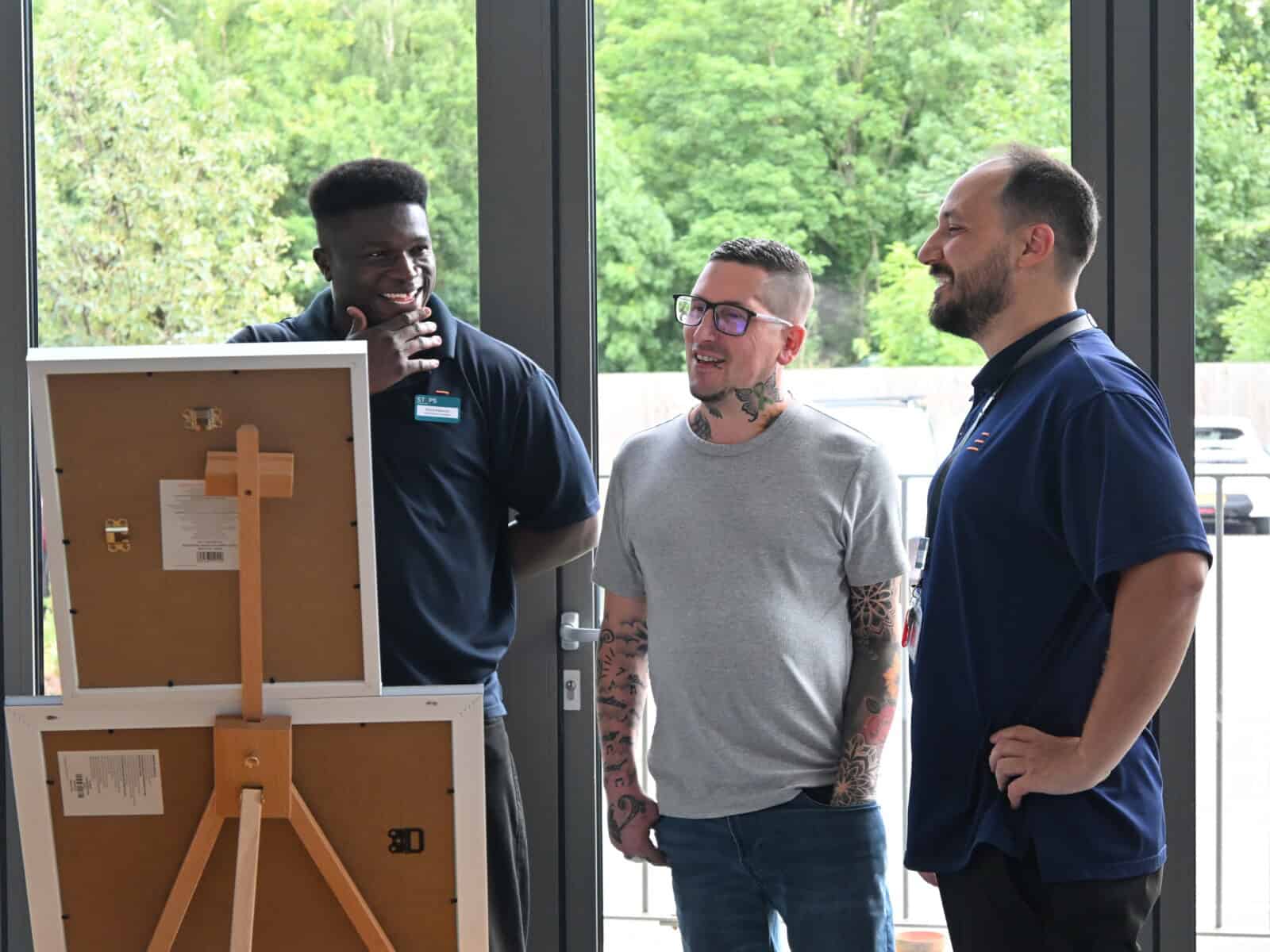
The team found some of Bob's pre-accident drawings, which helped re-establish his creative identity and reminded him that he was, fundamentally, a creative person. A particular milestone came when Bob completed his first canvas painting, a dramatic depiction of mountains, which Max describes as a visibly profound moment for him. Bob has continued painting and drawing every day since leaving STEPS and has since brought a piece back to the centre, which now hangs on the wall as a reminder of the therapeutic value of the work.
Occupational Therapy: Rebuilding Independence
Specialist Rehabilitation Occupational Therapist, Tayla Brons started working with Bob from the day he arrived to rebuild his independence from the ground up.
"Bob arrived really vulnerable," Tayla recalls. "His occupational performance was poor, and he relied on others for all his daily activities, including dressing, toileting and mobility. You could see this had significantly affected his self-identity and self-esteem."
Therapy began with the daily living basic skills stimulating movement and sensation in his right arm and hand, which had very little function on arrival. Sessions progressed to domestic activities such as cooking, then to community access, always working closely alongside the psychology and hypnotherapy teams to address the emotional and behavioural side of his recovery. Tayla also helped coordinate regular reviews with Bob's case manager, solicitors and family.
"When Bob first came to STEPS, he was very vulnerable and had very low self-esteem. By the time he left, he had a phased discharge including weekends at home and was able to start was living independently, taking his daughter to school and fulfilling his roles as a father, a friend and a son."
Remarkable Moments
The team's approach was always to expose Bob to a variety of settings and experiences as his rehabilitation progressed, alongside his structured therapy programme. Given his love of climbing, one of the most memorable moments of his time at STEPS came during his first community climbing session, when he reached the top of the wall for the first time since his injury.
Other highlights included community trips taking the centre's staff dogs for walks, cycling, hiking, and flying his drone in the Peak District, drawing on the fine motor control he had been rebuilding through therapy.
Life After STEPS
Bob left STEPS Rehabilitation in April 2023, after a nine-month stay, having exceeded all of the goals he set on his very first day. He now lives independently, with minimal support.
He has achieved his central goal of taking his daughter, now 13, to school. She stays with him regularly, and the two go bowling and to the cinema together, as well as planning future walking trips in the Lake District.
His days now include feeding his 15 ducks, for whom he built a wooden coop, along with the gym, physiotherapy twice a week, walking, bowling, drawing and painting, salsa dancing, photography and flying his drone. He is currently in the process of buying an accessible house with land for his animals.
Reflecting on his recovery, Bob says:
"I wouldn't be where I am now if I hadn't come to STEPS. That was the springboard to this life. STEPS is my first home; I don't remember life before the accident, but STEPS is where my brain woke up and made more, and better, connections. It changed my life."
"STEPS is your best possible chance of making the most recovery you can. Every therapist in the building is highly trained, and every brain injury is different. I would always recommend STEPS. It's nothing like a hospital: the team of therapists are incredible, and everyone is there for you 24/7."